Information Disclosure in Line with TCFD and TNFD Recommendations
June 1, 2026
The impacts of climate change on the economy, society, and the environment are becoming increasingly severe each year.
Global efforts toward achieving a decarbonized society are accelerating, and companies are required to respond appropriately.
In October 2022, we expressed its support for the recommendations of the Task Force on Climate-related Financial Disclosures (TCFD)*1 and has been disclosing information in line with these recommendations. In July 2025, with the aim of strengthening initiatives related to biodiversity, we also endorsed the recommendations of the Taskforce on Nature-related Financial Disclosures (TNFD) *2 and registered as a TNFD Adopter*3. We will continue to disclose climate-related and nature-related information in line with the TNFD recommendations and framework*4 while engaging in dialogue with stakeholders.
*1: A climate-related financial disclosure task force established by the Financial Stability Board at the request of the G20 to consider climate-related information disclosures and how financial institutions should respond.
*2: An international initiative that aims to establish a framework for companies and organizations to assess and disclose information on the impact of their economic activities on natural environment and biodiversity.
*3: Companies and organizations that have registered and declared their willingness to disclose information in accordance with the TNFD Recommendations on the TNFD website.
*4: The TNFD Framework requires companies to assess and disclose the risks and opportunities their business activities present in terms of their relationships (dependencies and impacts) concerning natural capital and biodiversity.


Governance
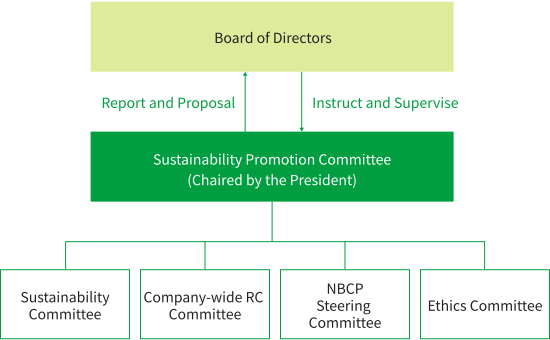
In order to build positive relationships with various stakeholders based on our corporate philosophy and become a company that is trusted and relied upon by others, we shifted our focus from CSR (Corporate Social Responsibility) activities to sustainability activities that contribute to all stakeholders by creating value through corporate activities, and established the Sustainability Promotion Committee in 2022 to promote activities that reflect a sense of urgency.
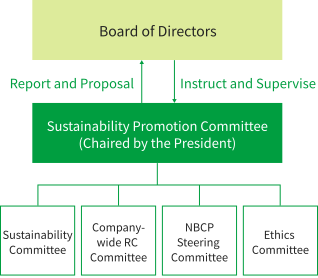
Chaired by the President, the Sustainability Promotion Committee deliberates on the basic policy on sustainability and other matters related to sustainability.
The Sustainability Committee was established under the direct control of the Sustainability Promotion Committee. The Committee promotes initiatives related to sustainability, including those that address climate change as well as biodiversity and other natural capitals, and the certification of environmental contribution products.
The Board of Directors receives reports and proposals concerning important matters deliberated on by the Sustainability Promotion Committee and also provides instruction and supervision concerning policies as well as action plans for addressing climate change and natural capital-related issues.
■ Governance Structure
Risk Impact and Management
In accordance with our Risk Management Policy, we analyze the degree of impact that risks may have on its business activities, while taking into account the characteristics of our businesses and the surrounding business environment, and manages such risks within the framework of the Sustainability Promotion Committee. All risks, including climate-related and nature-related risks, are identified by each department. These risks are then classified and compiled into a risk list by a management-level committee comprising heads of business divisions, and are evaluated based on their frequency, degree of impact, and level of control.
For the risks thus assessed, the Sustainability Promotion Committee examines fundamental solutions, including root causes, early detection, training, and measures to prevent recurrence, and implements preventive measures to avoid the occurrence of issues. Risk assessments are conducted once a year.
With regard to climate change risks, we conducted evaluations based on scenario analysis. For nature-related risks, we identified assessment areas by focusing on objective and qualitative materiality in our direct operations and the upstream value chain, and evaluated these risks accordingly.
Based on the CSR Procurement Guidelines established in July 2025, we are working collaboratively with suppliers to reduce environmental impacts. In addition, in order to quantitatively assess climate change risks, we introduced an Internal Carbon Pricing (ICP) system in April 2024. ICP (JPY 3,000 per metric ton of CO₂ equivalent) is applied to capital investment plans for low-carbon and decarbonization facilities, and is used as one of the indicators in investment decision-making.
Strategy 1: Climate Change
In recent years, large-scale wildfires and floods, believed to be caused by global warming, have occurred frequently around the world, and the impact of climate change on society has become increasingly severe. In order to prevent global warming, the international community is calling on countries and companies to take action toward the realization of a decarbonized society.
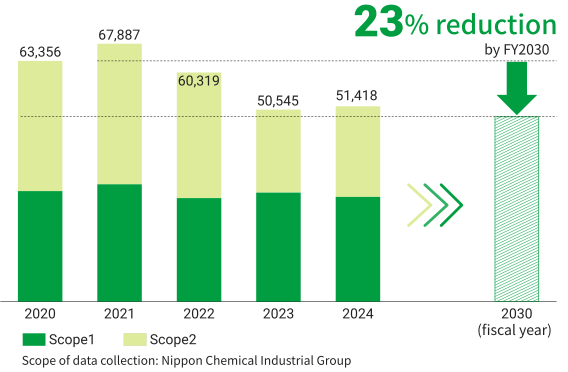
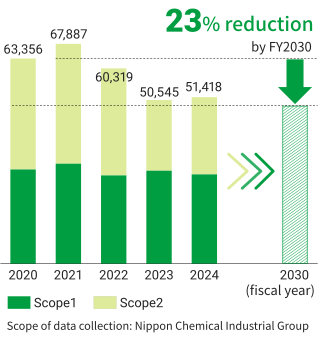
Recognizing climate change response as a critical management issue, we have set a target to reduce greenhouse gas (GHG) emissions by 23% by fiscal year 2030 compared with fiscal year 2020 levels. In addition, we define products that contribute to solving environmental issues and to environmental improvement throughout their entire life cycle as “environmental contribution products.” We have established a policy to proactively provide these products to the market and have set the ratio of sales from environmental contribution products to total sales as a key performance indicator (KPI), promoting company-wide initiatives.
To enhance stakeholders’ understanding of our initiatives, we will continue to disclose climate change–related information, including progress in reducing GHG emissions, the volume of waste generated, emissions of environmentally hazardous substances, and the sales ratio of environmental contribution products, and will strive to enhance corporate value.
The 1.5°C scenario*1
In this scenario, aggressive measures will be taken to combat climate change to keep the increase in temperatures in 2100 over temperatures at the time of the Industrial Revolution to around 1.5°C. In this scenario, climate change measures are strengthened and transition risks in terms of policy-driven regulations, markets, technology, and reputation are heightened.
*1: The RCP2.6 scenario, with reference made to information provided by the Inter-Governmental Panel on Climate Change (IPCC) and International Energy Agency (IEA), the parameters for estimating the impact of climate change is used to set.
Under the decarbonization scenario (1.5°C), increases in costs are anticipated due to factors such as the introduction of carbon taxes resulting from stricter environmental regulations, rising electricity prices driven by increased demand for renewable energy, and higher procurement costs stemming from global efforts to mitigate global warming.
On the other hand, demand from the market for environmental contribution products—such as electronic ceramic materials and phosphine derivatives, which are among our growth areas—is expected to increase further, creating additional business opportunities. We recognize the reduction of CO₂ emissions generated in its production processes as a key issue and is working to reduce emissions through initiatives such as the use of renewable energy and the introduction of decarbonization technologies at manufacturing sites. In procurement activities, we aim to reduce CO₂ emissions associated with raw materials while ensuring stable procurement, through ongoing communication with suppliers.
The 4°C scenario*2
In this scenario, aggressive measures will not be taken to combat climate change, the temperatures in 2100 will increase by around 4°C over temperatures at the time of the Industrial Revolution. This is a scenario in which physical risks will increase, such as in terms of more devastating natural disasters, rising sea levels, and more extreme weather events.
*2: The RCP8.5 scenario, with reference made to information provided by the Inter-Governmental Panel on Climate Change (IPCC) and International Energy Agency (IEA), the parameters for estimating the impact of climate change is used to set.
Natural disasters are difficult to forecast and if one were to occur, it is possible that we will sustain massive damage if, for example, our production sites are affected or there is a leak of chemical substances. In order to avoid a stoppage of operations due to a damaged facility or leak of chemical substances, we will need to make capital investments informed by disaster countermeasures, which we assume will lead to increased production costs. This trend will be amplified in the progressive warming scenario (4°C).
In order to deal with climate change risks and other aspects of major disasters, we have set up a specialized committee and formulated a BCP (Business Continuity Plan) system on a company-wide basis to minimize the impact on our business activities even in an emergency. We will continue to promote ongoing improvements to our BCP system.
■ Risks and Opportunities
Our risks and opportunities under the 1.5°C and 4°C climate change scenarios are presented below.
(1)1.5°C climate change scenario
| Items corresponding to opportunities | Changes in the wider world | Possible scenario | Risk | Opportunity | Timing of occurrence |
|---|---|---|---|---|---|
| Policies, laws, and regulations | Tightening of regulations governing GHG emissions and environmental considerations | Incurrence of costs to comply with regulations and costs to transition to decarbonization | △ | Medium to long term | |
| Markets and technologies | Introduction of carbon tax and emissions trading | Incurrence of costs to introduce a carbon tax and emissions trading | ◎ | Medium to long term | |
| Rapidly promoting the transition to a low-carbon/decarbonized world | Incurrence of costs to make capital investments and convert to renewable energy | △ | Short to medium term | ||
| Declarations of carbon neutrality made by industry associations and governments | Promoting CO₂ reductions through the use of renewable energy | ○ | Short to medium term | ||
| Developing and promoting the spread of decarbonization-related products | Increase in demand for various environmental contribution products downstream and increase in demand for and revenue from products that we provide and that are used as materials for such products | ◎ | Medium to long term | ||
| Soaring resource prices | Our competitiveness suffers from the rise of overseas companies operating in countries where production can be undertaken on a low-cost basis | △ | Long term | ||
| Increase in the costs of procuring raw materials | ○ | Medium to long term |
(2)4°C climate change scenario
| Items corresponding to opportunities | Changes in the wider world | Possible scenario | Risk | Opportunity | Timing of occurrence |
|---|---|---|---|---|---|
| Reputation | Stricter evaluations of companies that have not yet decarbonized and that are emitting large volumes of CO₂ | CO₂ reductions are sought across the entire value chain in downstream industries and demand fluctuates due to initiatives taken by us and our production lines | ○ | ○ | Medium to long term |
| Chronic | Changes in precipitation and weather patterns (increased rainfall and rising average temperatures) | Ensuring the safety of employees in the face of increased rainfall | △ | Long term | |
| Risk of reduced sales and impairment losses affecting production facilities due to shutdowns or lower production | △ | Long term | |||
| Acute | Intensification and increase in the number of natural disasters (typhoons, wildfires, flooding, and severe storms) | Disruptions in the supply of raw materials due to natural disasters | ○ | Long term | |
| Risk of the leakage of chemical substances due to damage caused to production plants | ○ | Long term | |||
| Incurrence of capital investment costs related to disaster countermeasures at key locations | ○ | Medium to long term |
◎: Large impact ○: Somewhat large impact △: Negligible impact
- *Large impact: Impact on business and finances is expected to be exceedingly large
- *Somewhat large impact: Impact on business and finances is expected to be somewhat large
- *Negligible impact: Impact on business and finances is expected to be negligible
- *Short to medium term: Occurrence between now and 2030 is highly probable
- *Medium to long term: Occurrence between 2030 and 2050 is highly probable
- *Long term: Occurrence from 2050 onward is highly probable
Metrics and Targets 1: Climate Change
In order to contribute to the realization of a decarbonized society, we have set a target to reduce CO₂ emissions by 23% by FY2030 compared to FY2020 levels, taking into account the emission reduction levels required under the Paris Agreement. This target covers Scope 1 emissions (direct emissions from business activities) and Scope 2 emissions (indirect emissions from the use of purchased electricity and other sources), with FY2020 emissions of 63,356 tons used as the baseline.
In FY2024, our consolidated GHG emissions totaled 51,418 tons, consisting of 27,597 tons for Scope 1 and 23,821 tons for Scope 2, representing a slight increase compared to the previous fiscal year.
We will aim to reduce GHG emissions and realize a decarbonized society by utilizing renewable energy and introducing decarbonization technologies at our production sites and striving to conserve energy and electricity.
GHG Emissions and Medium-term Reduction Targets
(Emissions for FY2025 are currently under calculation.)
■ GHG Emissions
■ Breakdown of Scope 3 by Category
| Scope/Category | Category | FY2022 CO₂ emissions |
FY2023 CO₂ emissions |
FY2024 CO₂ emissions |
|
|---|---|---|---|---|---|
| (t-CO₂) | (t-CO₂) | (t-CO₂) | |||
| Scope 3 | Total for all categories | 212,874 | 190,722 | 217,211 | |
| Breakdown of Scope 3 | Category 1 | Purchased goods and services | 163,369 | 145,798 | 179,636 |
| Category 2 | Capital goods | 13,185 | 8,260 | 8,630 | |
| Category 3 | Fuel- and energy-related activities * Not included in Scopes 1 and 2 |
10,986 | 9,367 | 6,981 | |
| Category 4 | Upstream transportation and distribution * Procurement logistics, horizontal logistics, and shipping logistics for which the company is the shipper |
19,587 | 21,202 | 16,183 | |
| Category 5 | Waste generated in operations | 600 | 816 | 703 | |
| Category 6 | Business travel | 222 | 318 | 438 | |
| Category 7 | Employee commuting | 588 | 676 | 550 | |
| Category 8 | Upstream leased assets | Not applicable to calculation | Not applicable to calculation | Not applicable to calculation | |
| Category 9 | Downstream transportation and distribution * Shipping transportation (other companies are the transport shippers), storage in warehouses, and sales at retail stores |
Not applicable to calculation | Not applicable to calculation | Not applicable to calculation | |
| Category 10 | Processing of sold products |
Not applicable to calculation | Not applicable to calculation | Not applicable to calculation | |
| Category 11 | Use of sold products | Not applicable to calculation | Not applicable to calculation | Not applicable to calculation | |
| Category 12 | End-of-life treatment of sold products | Not applicable to calculation | Not applicable to calculation | Not applicable to calculation | |
| Category 13 | Downstream leased assets | 4,338 | 4,286 | 4,091 | |
| Category 14 | Franchises | Not applicable to calculation | Not applicable to calculation | Not applicable to calculation | |
| Category 15 | Investments | Not applicable to calculation | Not applicable to calculation | Not applicable to calculation | |
No third-party guarantees have been received for emissions in FY2022.
The Group’s CO₂ emissions are calculated in accordance with the GHG Protocol and are verified by a third-party organization to improve reliability and transparency.
Strategy 2: Natural Capital
LEAP Approach
We utilized the LEAP Approach developed by TNFD in our analysis for evaluation and management purposes related to natural capital. The LEAP approach consists of four processes: Locate (interface with nature), Evaluate (identifying and assessing dependencies and impacts on nature), Assess (nature-related risks and opportunities), and Prepare (to respond to, and report on, material nature-related issues).
Locate Phase: Locate Interface with Nature
In the Locate phase, we defined the scope to include our direct operations and the upstream value chain (raw materials and fuels). For direct operations, all four domestic production sites were selected. For the upstream value chain, we selected a total of eight suppliers that provide commodities listed in the High Impact Commodity List*2 published by the Science Based Targets Network for Nature (SBTN) *1 and that are closely related to our business, as well as suppliers of raw materials and fuels for products with high sales ratios. Using the tools described below, we analyzed the surrounding natural conditions and identified areas of potential concern.
- *1: A framework that encourages companies and municipalities to set nature-related targets based on science.
- *2: SBTN’s list of commodities (raw materials) that are considered to have a significant impact on nature.
We utilized the analysis tools and databases recommended by SBTN to identify areas requiring attention. Areas requiring attention are identified where one or more of the following five criteria listed in the TNFD Recommendations apply.
- Areas of importance for biodiversity (analysis tool: IBAT*1)
- Areas of high ecosystem integrity (analysis tool: GFW*2)
- Areas of rapid decline in ecosystem integrity (analysis tool: GFW)
- Areas of importance for ecosystem service provision, including benefits to Indigenous peoples, local communities, and stakeholders (analysis tool: GFW)
- Areas of high physical water risks (analysis tool: Aqueduct*3)
- *1:Integrated Biodiversity Assessment Tool
- *2:Global Forest Watch (an online system for monitoring forests on a global scale using high-resolution satellite images)
- *3:A data platform on water risk provided by WRI (World Resources Institute)
Based on the analysis obtained using the aforementioned analytical tools and databases, the following priority areas were identified.
■ Summary of Priority Areas
As of June 1, 2026
| Production site name | Location | Identification of areas requiring attention | |||
|---|---|---|---|---|---|
| Areas of importance for biodiversity | Ecosystem integrity | Areas of high physical water risks | Provision of important ecosystem services | ||
| Fukushima No. 1 Factory | Koriyama City, Fukushima Prefecture | There are four production sites in Japan, and several IBAT indicators applied to all four. Accordingly, biodiversity is considered to be of high importance for these areas. | Not an area in which ecosystem integrity is high nor in which it is in rapid decline. | Not a high water risk area. | Not areas of importance for ecosystem service provision, including benefits to Indigenous peoples, local communities, and stakeholders |
| Fukushima No. 2 Factory | Tamura District, Fukushima Prefecture | Not an area in which ecosystem integrity is high but there is a possibility it is in rapid decline. | |||
| Aichi Factory | Chita District, Aichi Prefecture | Not an area in which ecosystem integrity is high nor in which it is in rapid decline. | |||
| Tokuyama Factory | Shunan City, Yamaguchi Prefecture | Not an area in which ecosystem integrity is high nor in which it is in rapid decline. | |||
| Suppliers (upstream) | 8 sites (worldwide) |
Multiple IBAT analysis indicators applied to six of the eight suppliers. Accordingly, biodiversity is considered to be of high importance for these areas. | All eight suppliers are not located in areas in which ecosystem integrity is high nor in areas in which it is in rapid decline. | Water stress applies to one of the eight suppliers and riverine flood risk applies to one supplier. | |
Evaluate Phase: Identify and Evaluate Dependencies and Impacts on Nature
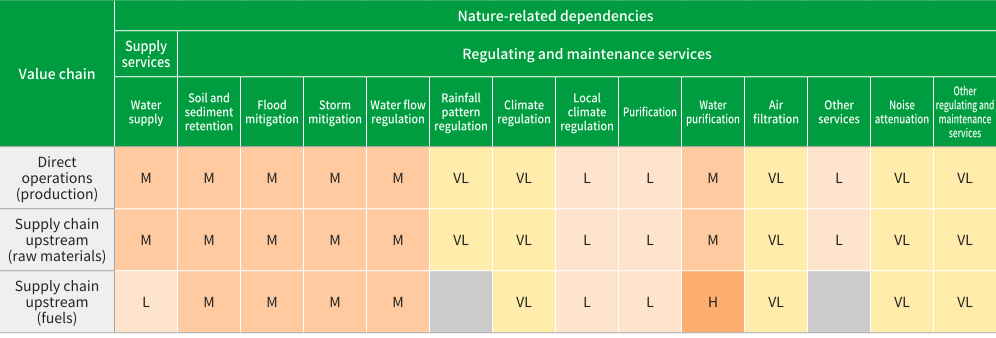
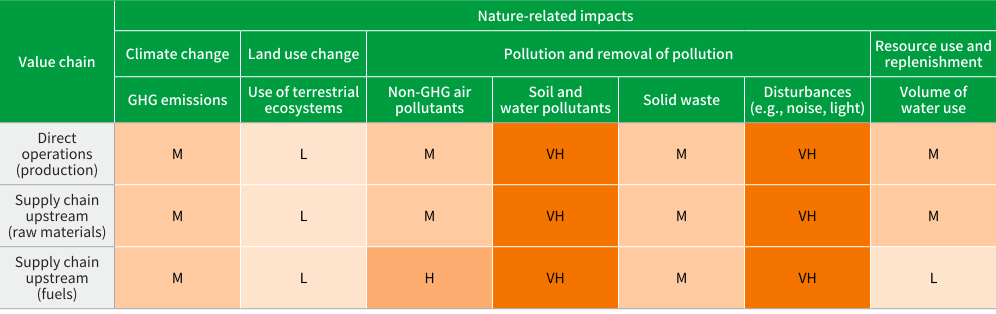
To identify our nature-related dependencies and impacts, we conducted a survey using ENCORE*1 and aggregated the individual results using a heat map.
*1: ENCORE (Exploring Natural Capital Opportunities, Risks, and Exposure), a tool jointly developed by the Natural Capital Finance Alliance—a network of financial institutions–and the United Nations Environment Programme World Conservation Monitoring Centre (UNEP-WCMC). The tool provides a list of potential nature dependencies and impacts, flowcharts, and other information.
Based on the information (heat maps) obtained through ENCORE, we identified and assessed our nature-related dependencies and impacts across our direct operations and upstream value chain operations (raw materials and fuels).
With regard to nature-related dependencies, all dependency categories were assessed as medium or below for our direct operations and upstream value chain operations (raw materials). For upstream value chain operations related to fuels, “water purification” was assessed as high, while all other categories were assessed as medium or below.
With regard to nature-related impacts, “soil and water pollutants” and “disturbances (e.g., noise and light)” were identified as particularly high for our direct operations and upstream value chain operations (raw materials), while all other impact categories were assessed as medium or below. For upstream value chain operations related to fuels, “soil and water pollutants” and “disturbances (e.g., noise and light)” were identified as particularly high, and “non-GHG air pollutants” were assessed as high, while all other categories were assessed as medium or below.
■ Dependencies Heatmap

■ Impact Heatmap
Assess Phase: Assess Nature-related Risks and Opportunities
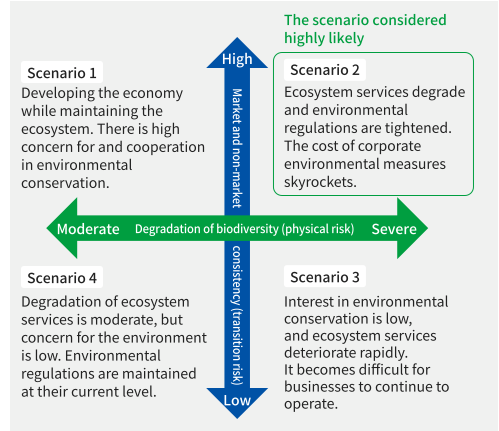
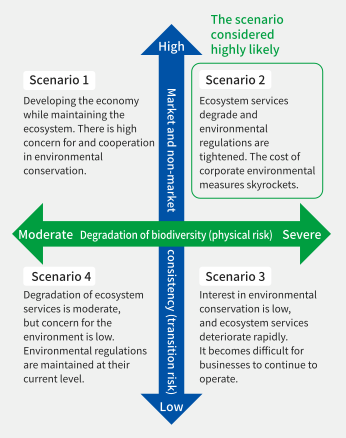
In identifying risks and opportunities, we conducted an analysis of scenarios based on TNFD guidance. The analysis was divided into four scenarios based on the degree of market and non-market consistency (transition risk) and degradation of ecosystem services (physical risk).
Of the scenarios presented on the right, Scenario 2 was considered the most feasible. Based on this scenario plus the priority areas identified in the Locate phase and the nature-related dependencies and impacts identified and evaluated in the Evaluate phase, and also taking into consideration our definitions of the time horizons of risks and opportunities*1 , we identified the risks and opportunities related to natural capital that we believe are important to us. We also considered how to respond to the identified risks and opportunities, taking into account our business lines, geographic regions, and value chain.
*1: Defined as short-term (less than 3 years), medium-term (more than 3 years to 10 years ahead), and long-term (more than 10 years to 30 years ahead).
■ TNFD Scenario Analysis
■ Summary of Nature-related Risks and OpportunitiesSummary of Nature-related Risks and Opportunities
| Risk/ Opportunity |
Area | Important dependencies and impacts | Type of risk/opportunity | Timing of occurrence | Risk/Opportunity factors | Countermeasures | |
|---|---|---|---|---|---|---|---|
| Risk | Upstream | Tighter nature-related regulations | Transition risk | Markets and technologies | Medium to long term | Increased procurement costs due to tighter environmental regulations in raw fuel producing regions. | Strengthen supplier engagement and devise measures with suppliers. |
| Water stress, flooding | Physical risk | Chronic | Medium to long term | Unstable supply due to water issues in raw material production regions. | Reduce procurement risk by diversifying procurement regions and suppliers. | ||
| Direct operations | GHG emissions | Transition risk | Markets and technologies | Medium to long term | If GHG emissions from production activities cannot be reduced, the costs associated with carbon taxes and emission credits will increase. | Reduce GHG emissions by improving productivity, utilizing renewable energy, and introducing decarbonization facilities. | |
| Solid waste generation and release | Transition risk | Reputation | Long term | Increasing calls from municipalities and citizens for solid waste reduction and circular economy promotion, increasing waste disposal costs. | Reduce solid waste by improving productivity, promoting recycling, etc. | ||
| Water supply | Physical risk | Chronic | Medium to long term | Inability to secure the water needed for production restricts the manufacture of products. | Gain understanding of water consumption per unit of production. Promote efficient use of water and reduce water consumption. Secure stable water supply by maintaining water storage capacity and diversifying water sources. |
||
| Flooding and storms | Physical risk | Acute | Medium to long term | Disaster countermeasure costs incurred at major production sites. | Prepare for disasters and routinely reinforce facilities and emergency materials. Standardize response procedures and provide education and training. |
||
| Flooding and storms | Physical risk | Chronic | Long term | Flooding causes shutdowns or reduced production, resulting in lower sales and impairment losses on manufacturing facilities. | Prepare for disasters and routinely reinforce facilities. | ||
| Water purification | Physical risk | Chronic | Long term | Deterioration in the quality of water used results in deterioration in product quality and incurs purifying costs. | Maintain water storage capacity and consult with government agencies. | ||
| Opportunity | Upstream | Carbon neutrality | Transition opportunity | Markets and technologies | Medium to long term | Meet environmental regulations through decarbonization at raw fuel suppliers. | Utilize renewable energy at suppliers’ manufacturing sites. |
| Direct operations | Developing and promoting the spread of decarbonization-related products | Transition opportunity | Markets and technologies | Medium to long term | The expansion of the decarbonization market increases sales of our environmental contribution products and improves profitability. | Develop and promote sales of environmental contribution products, improve processes, and promote recycling. | |
| Carbon neutrality | Transition opportunity | Markets and technologies | Short to medium term | Our carbon neutrality efforts are appreciated by stakeholders and the value of the Company in the market rises. | Reduce GHG emissions associated with our products by utilizing renewable energy and improving processes. | ||
Metrics and Targets 2: Natural Capital
Prepare Phase: Prepare to Respond and Report
Based on the results of our analysis of the identified risks and opportunities, we further selected the indicators and targets related to natural capital that we considered most important in light of our medium- to long-term strategy. We have identified these issues as materialities and are addressing them with KPIs. We aim to achieve these KPIs while allocating internal resources as appropriate.
■ Indicators and Targets for Natural Capital
| Item | Indicator | Target | FY2024 results |
|---|---|---|---|
| GHG emissions | Scope1, 2 | Reduce GHG emissions in FY2030 by 23% compared to FY2020 | 18.8% |
| Ratio of environmental contribution product sales to net sales | Sales of environmental contribution products | Achieve a ratio of environmental contribution product sales to net sales ratio of at least 14% in FY2025. | 11.3% |
Going forward, we will disclose indicators with reference to the TNFD core global disclosure indicators and strive to reduce our environmental impact.
■ Core Global Disclosure Indicators for Dependencies and Impacts
| Dependency/impact indicator | Scope | Unit | 2022 | 2023 | 2024 | |
|---|---|---|---|---|---|---|
| GHG emissions (Scope 1+2) | non-consolidated | t-CO₂e | 60,319 | 50,545 | 51,418 | |
| Soil pollutants (PRTR substances) | non-consolidated | tons | 0 | 0 | 0 | |
| Wastewater | thousand m3 | non-consolidated | thousand m3 | 1,629 | 1,712 | 1,655 |
| COD | non-consolidated | tons | 5.6 | 7.1 | 5.8 | |
| Total phosphorus | non-consolidated | tons | 3.4 | 3.2 | 3.2 | |
| Total nitrogen | non-consolidated | tons | 13.3 | 14.6 | 13.0 | |
| PRTR substances | non-consolidated | tons | 0.066 | 0.056 | 0.059 | |
| Waste | Total industrial waste discharged | non-consolidated | tons | 9,056 | 11,732 | 11,023 |
| Total specially controlled industrial waste discharged | non-consolidated | tons | 1,110 | 1,968 | 1,208 | |
| Incineration | non-consolidated | tons | 3,384 | 5,157 | 4,712 | |
| Landfill disposal | non-consolidated | tons | 757 | 1,719 | 840 | |
| Other disposal methods | non-consolidated | tons | 1,581 | 1,654 | 1,920 | |
| Disposal method unknown | non-consolidated | tons | 0 | 0 | 0 | |
| Recycled amount | non-consolidated | tons | 3,322 | 3,290 | 3,780 | |
| Air pollution | Volatile organic compounds (VOC) (VOC) | non-consolidated | tons | 12.9 | 7.5 | 10.5 |
| NOx | non-consolidated | tons | 10.8 | 11.5 | 11.3 | |
| SOx | non-consolidated | tons | 0.9 | 1.2 | 1.2 | |
| Particulate matter | non-consolidated | tons | 2.5 | 2.5 | 2.1 | |
| PRTR substances | non-consolidated | tons | 4.2 | 1.7 | 1.5 | |
| Compliance breaches | non-consolidated | Cases | 0 | 0 | 0 | |
| Recycling of hazardous waste in manufacturing processes | non-consolidated | % | 0.468% | 0.277% | 0.477% | |
| Recycling of used hazardous waste | non-consolidated | % | 36.2% | 27.8% | 34.3% | |
Going forward, we will continue to proactively disclose information on climate change and natural capital with reference to the TNFD Framework. We will also seek to enhance and promote our sustainability initiatives by reflecting feedback received from our stakeholders, with the aim of contributing to the realization of a sustainable society.