RC Management
As a business that handles chemical substances, we will contribute to the realization of a sustainable society by protecting the environment, health, and safety based on self-determination and self-responsibility at all stages of product development, manufacturing, distribution, use, final consumption, and disposal, and by continuously improving our efforts.
Responsible Care Initiatives
RC Basic Policy
We have established a Basic Policy on Responsible Care to facilitate our Responsible Care activities.
❶ Compliance with laws and regulations
We will comply with domestic and foreign laws and regulations, and cooperate with international organizations, domestic and foreign administrative agencies, and non-governmental organizations.
❷ Environmental conservation
In order to be environmentally conscious and conserve the environment in our business activities, we will strive to develop technologies that take into account resource and energy conservation and waste reduction at the product planning stage, as well as to use and reuse resources and energy more efficiently in our production activities.
❸ Safety and disaster prevention
To prevent accidents, disasters, and pollution, we will maintain safe and stable operations and conduct practical drills in preparation for emergencies.
❹ Occupational health and safety
We will place the highest priority on creating a safe and secure workplace and will engage in health and safety activities on an ongoing basis.
❺ Product safety
We evaluate environmental conservation and safety assurance at all stages of our products, from research and development through manufacturing, sales, and disposal, to provide safe products with minimal environmental impact, and will supply customers with the necessary information regarding the safe use and handling of our products.
❻ Logistics safety
We will strive to prevent accidents in our logistics.
❼ Voluntary audits
We will evaluate the status of implementation of environmental conservation and safety assurance measures of each division through internal audits and work toward continued improvement.
❽ Awareness of responsibilities by all employees and the improvement of our relationship of trust with society
Based on our philosophy and policies, all of us, from management to employees, will be aware of our responsibilities, promote measures to ensure environmental conservation and safety assurance, and strive to improve our relationship of trust with society.
❾ Self-management
As necessary, we will establish management items and standard values that are stricter than the regulatory standards set forth in laws, regulations, and ordinances. Further, even in cases where there are no laws or regulations, we will voluntarily establish management items and standard values for chemical substances, materials, and manufacturing methods, etc. that are recognized as potentially having a significant adverse impact on the environment and safety.
Organization Chart
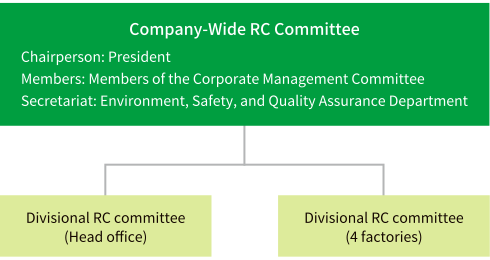
The Company-Wide RC Committee (chaired by the President and whose members are members of the Corporate Management Committee) is the company-wide RC supervisory body. It is composed of five divisions under it consisting of the Head Office Division RC Committee and divisional RC committees for each of the four factories.
Safety and Disaster Prevention
At each of our locations, we conduct periodic drills based on various possible risks, such as sudden accidents and natural disasters. In addition, we are continuously improving our security and disaster prevention activities through audits and other means.
Safety and Disaster Prevention Initiatives
RC Audits (Head Office)
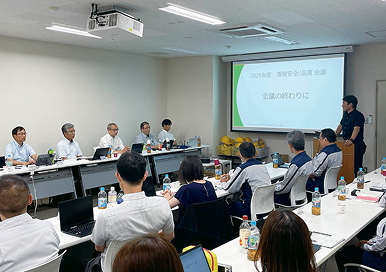
Through responsible care (RC) audits, we confirm that our efforts to prevent accidents and disasters as well as to prevent environmental complaints are being properly implemented. For our departmental RC audits, the Environment, Safety and Quality Assurance Department acts as the auditor and audits RC activities at five workplaces (the Head Office and factories) once a year. Audit results are reported and summarized by the Company-Wide RC Committee for use in making further improvements.
Safety and Disaster Prevention (Tokuyama Factory)
The risk of natural disasters such as earthquakes and tsunamis has been increasing in recent years. The Tokuyama Factory, which handles many deleterious materials, toxic substances, and high-pressure gases, requires measures that take these characteristics into account.
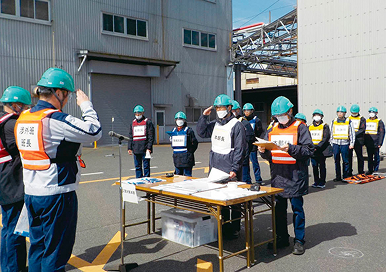
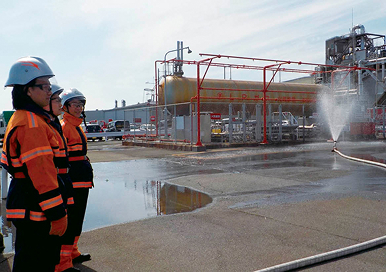
We conduct comprehensive disaster drills at the factory every year. The drill scenario simulates liquified petroleum gas and heavy oil leaks and fires caused by a major earthquake. During the drills practice measures that would be actually be carried out in a real disaster, such as using gas detectors and other equipment to assess the impact on the surrounding area, extinguishing fires, reporting to the authorities, rescuing injured people, and confirming the evacuation and safety of on-site personnel.
In addition, with regard to natural disasters, which are difficult to predict, all employees will continue to work together to improve the level of safety and disaster prevention by engaging in drills that simulate various events.
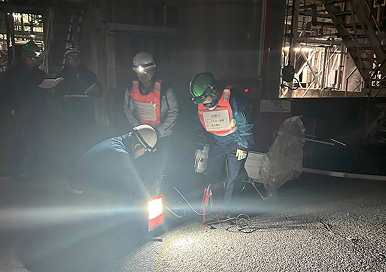
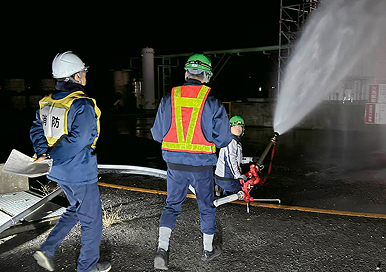
Nighttime Disaster Drill (Aichi Factory)
On December 16, 2024, at 6:00 p.m., we conducted a fire drill simulating a fire resulting from yellow phosphorus leaking from a tank during the night.
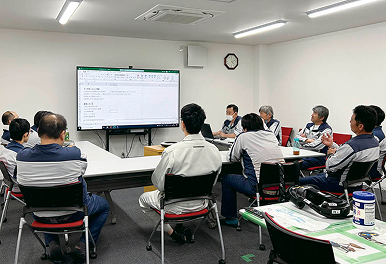
Since the factory is operated by a small number of employees at night, it is essential that a small number of personnel be able to extinguish fires safely and quickly. The drill included practicing calling the fire department, spraying water for initial firefighting, preparing lighting equipment, and collecting on-site wastewater. At the post-drill review meeting, participants exchanged opinions to increase their sense of ownership, further strengthen disaster prevention activities, and raise awareness of disaster prevention.
Occupational Health and Safety
Occupational Health and Safety Initiatives
At each of our locations, every employee takes personal responsibility and engages in activities such as near-miss activities, hazard prediction training, and workplace patrols. Labor and management are working together to prevent occupational accidents and illnesses.
■ Accident Frequency Rate
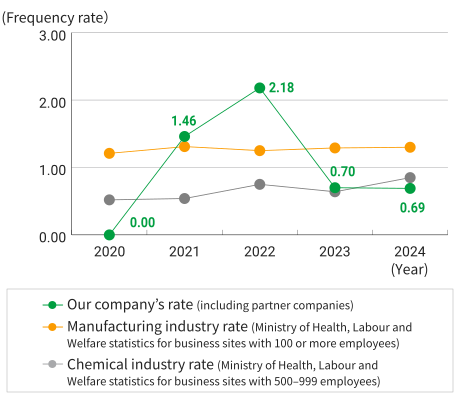
*Accident frequency rate: The frequency of occupational accidents is expressed in terms of the number of fatalities and injuries due to occupational accidents (resulting in one or more days lost from work) per million total labor hours.
■ Accident Severity Rate
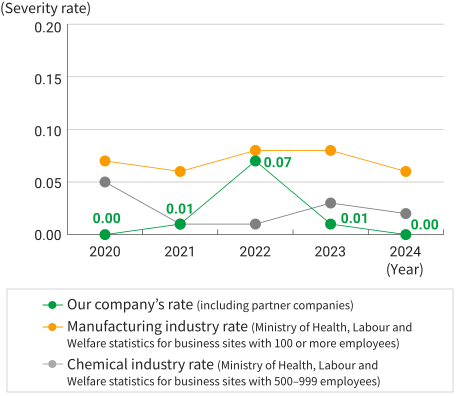
*Accident severity rate: The degree of severity of accidents expressed in terms of the total number of days of labor lost per 1,000 total labor hours.
*From FY2022, fiscal year-ends have been adjusted from April to March in order to align with other activity years. The figures presented in this graph have been retroactively recounted and therefore differ from previously reported values.
Introduction of a VR Hazard Simulation System
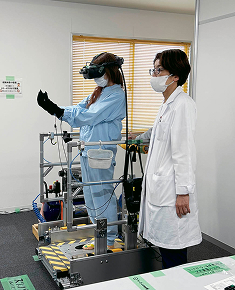
As part of our safety activities, we have introduced a virtual reality (VR)-based hazard simulation system, which is used for safety education at each business site. By providing employees with realistic experiences of workplace accidents such as falling down stairs or getting caught in rollers, we are better able to increase their awareness of these dangers. After employees use the VR system, they engage in discussions with each other about the causes of the accidents depicted and what preventative measures could have been taken. Through efforts such as this, we seek to prevent accidents and disasters by making it easier for employees to imagine them, effectively increasing their hazard perception.
Messages from Factory General Managers
Aiming for a Sustainable and Better Society