Corporate Governance
Basic Approach to Internal Controls
We will realize our basic management policy of “taking on the further challenge of becoming a value-creating company by becoming a highly profitable company in an era of changes in the market environment and providing high-quality products and services through the people and technologies that we have amassed over many years.” We regard corporate governance as rooted in shareholder interests as an important management matter and will endeavor to reinforce compliance by implementing various measures to enhance management oversight, disclosing company information on a timely and appropriate basis, improving corporate ethics, and complying with laws and regulations.
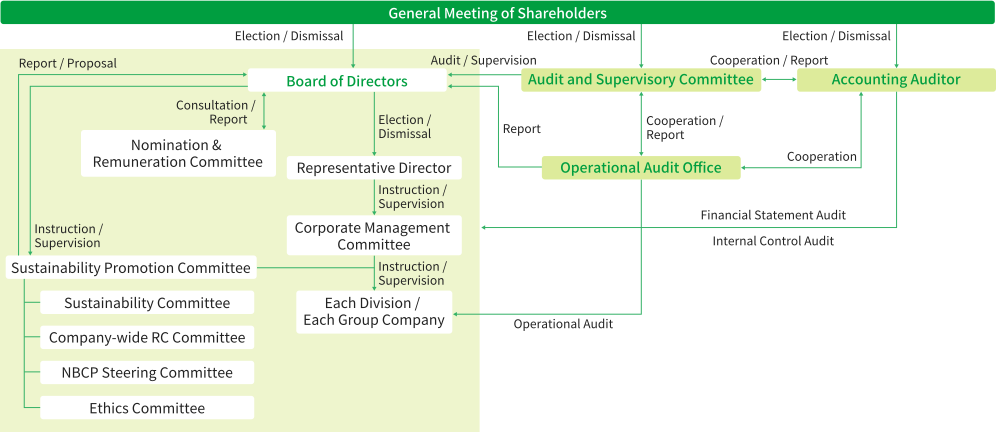
Corporate Governance Structure Chart
Policy on and Procedures for Electing Candidates for Officer Positions
The Company selects persons who can fulfill, as Directors, the management mandate conferred on them by shareholders, have a wealth of experience and high-level insight related to management, and are capable of fulfilling the duties and responsibilities of Directors as candidates for the Director position. After a draft of candidates for Director is prepared by the representative director and deliberations are undertaken by the Nomination & Remuneration Committee, candidates for Director are selected by the Board of Directors.
Where there has been an irregularity or a violation of a law or regulation or a breach of the Articles of Incorporation in the execution of duties by a Director, or where circumstances under which it can be deemed that the proper performance by a Director of his or her duties would be difficult have otherwise arisen, dismissal of the Director shall be proposed to the general meeting of shareholders.
It is also stipulated that a determination as to the election or dismissal of an Executive Officer shall be made through the adoption of a resolution by the Board of Directors.
-
❶ Board of directors
The Board of Directors is chaired by the Representative Director and consists of six Directors, three of whom are Outside Directors. Regular meetings of the Board of Directors are held for the purpose of quickly making managerial decisions and extraordinary meetings are held as needed. All matters as set forth by laws, regulations, and the Articles of Incorporation as well as all other matters as set forth in the Regulations Governing the Board of Directors as material matters concerning management shall be all submitted to the Board of Directors. Matters related to business performance progress are also reported and discussed by the Board of Directors when appropriate.
- At meetings of the Board of Directors, the Group’s operating results are reported, and management issues and countermeasures are reviewed and considered.
-
❷ Audit and supervisory committee
The Company is a company with an Audit and Supervisory Committee. The Audit and Supervisory Committee is comprised of one full-time member who is a Director and three part-time members who are Outside Directors. Directors who are members of the Audit and Supervisory Committee oversee and audit management of the Company by attending meetings of the Board of Directors and Corporate Management Committee, obtaining updates on the state of operational execution from Directors who are not members of the Audit and Supervisory Committee where necessary, and conducting regular audits of each division.
- Members of the Audit and Supervisory Committee supervise the decision-making process of the Company and its content by attending important meetings such as meetings of the Board of Directors and Corporate Management Committee.
- The Audit and Supervisory Committee receives reports on audits conducted by the Internal Audit Department and communicates with the Internal Audit Department (Operational Audit Office) to establish an effective audit system.
-
❸ Corporate management committee
The Corporate Management Committee is chaired by the Representative Director and consists of a Director who is a full-time member of the Audit and Supervisory Committee and Executive Officers, and it makes decisions on important matters concerning the execution of operations within each division. The Corporate Management Committee holds meetings, in principle, three times a month in order to speed up the decision-making process and improve the efficiency of the execution of operations. The functions of Directors who are in charge of making decisions and oversight duties are separated from the functions of Executive Officers who are in charge of the execution of operations and the responsibilities associated with both functions are clarified, then we improve the transparency and fairness of management and the soundness of corporate management.
-
❹ Operational audit office
The Operational Audit Office, consisting of one Manager and one other member, has been established as a body that operates directly under the control of the Board of Directors and is independent of the execution of other operations. This Office conducts internal audits of different internal organizations and affiliated companies in collaboration with the Audit and Supervisory Committee and reports the results of these audits to the Board of Directors and the members of the Audit and Supervisory Committee so that said results may be incorporated into the Company’s management.
- The Office conducts internal audits on each division of the Company and its group companies based on an annual audit plan.
- The Office works to further improve internal audits.
- The Company has set up the Operational Audit Office and contact points for reporting and consultation outside the Company for the purpose of the early detection, investigation, and correction of violations of laws and regulations as well as misconduct, and to protect the Group and its employees.
- Internal reports are summarized and reported to all Directors, including members of the Audit and Supervisory Committee.
-
Sustainability promotion committee
The Sustainability Promotion Committee deliberates on the Company’s basic policy on sustainability as well as other matters related to sustainability based on internal and external positions pertaining to ESG factors and SDGs and regularly reports and makes recommendations to the Board of Directors.
Four committees operate under the purview of the Sustainability Promotion Committee: Sustainability Committee, Company-Wide RC Committee, NBCP (Nippon Chemical Industrial Business Continuity Plan) Steering Committee, and Ethics Committee. The Sustainability Promotion Committee oversees and directs the activities of these four committees and works to reinforce and promote management through regular meetings.
The Sustainability Promotion Committee is chaired by the President and consists of Directors and Executive Officers who are in charge of the Corporate Strategy Division, Administration Division, Sales Division, Production Engineering Division, and R&D Division as well as members appointed by the Chairperson upon being deemed to be suitable in light of the objectives of the Sustainability Promotion Committee.
-
❺-1 Sustainability committee
Under the supervision of the Managing Executive Officer, the Sustainability Committee promotes initiatives related to sustainability, including those designed to provide value to , all stakeholders and address climate change and the circular economy.
-
❺-2 Company-Wide RC committee
The Company-Wide RC Committee is chaired by the President, promotes responsible care activities as they relate to the environment and safety, and works to maintain and improve levels of compliance with laws and regulations, environmental conservation, safety and disaster prevention, occupational health and safety, product safety, and logistics safety.
-
❺-3 NBCP (Nippon Chemical Industrial Business Continuity Plan) steering committee
The NBCP Steering Committee is chaired by the Executive Officer in charge of the Production Engineering Division and promotes continuous improvements to policies, plans, and drills as they relate to emerged and potential crises.
-
❺-4 Ethics committee
Chaired by the Executive Officer in charge of the Administration Division, the Ethics Committee endeavors to thoroughly disseminate the code of conduct to be observed by employees as they engage in their daily corporate activities and regularly checks the status of compliance in an effort to make continuous improvements.
-
❻ Nomination & remuneration committee
The voluntary Nomination & Remuneration Committee has been established in order to reinforce the Board of Director’s oversight functions and enhance the system of corporate governance by ensuring the transparency and objectivity of the process of assessing and determining matters related to the nomination and remuneration of Directors and Executive Officers in positions of responsibility.
This Committee consists of at least three members who are Directors, the majority of whom are selected from among independent Outside Directors.
The Chairperson is selected from among members who are independent Outside Directors.
As a rule, this Committee convenes at least once a year and shall deliberate on and report to the Board of Directors on the following matters that are consulted by the Board of Directors:
- Matters related to the composition of the Board of Directors
- Matters related to the election and dismissal of Directors and Executive Officers
- Matters related to the selection and dismissal of Representative Directors
- Matters related to criteria for determining the independence of Outside Directors
- Matters related to succession planning
- Matters related to the policy and procedures for determining the remuneration of Directors and Executive Officers
- Matters related to the contents of the remuneration of Directors and Executive Officers
- Agenda items to be submitted to a general meeting of shareholders (concerning an election, dismissal, or remuneration)
The internal regulations of the Company stipulate that the Nomination & Remuneration Committee shall consist of at least three members, the majority of whom shall consist of independent Outside Directors from the standpoint of ensuring the independence thereof. The Nomination & Remuneration Committee presently consists of one Representative Director and three independent Outside Directors, such that the majority of its members are independent Outside Directors.
Contact Points for Internal Reporting
The Company has set up contact points for internal reporting and consultation in the Operational Audit Office and outside the Company in order to prevent violations of the law and misconduct before they become serious matters and ascertain and correct issues as quickly as possible. In operating an internal reporting (whistleblowing) system, the Company has enacted regulations governing the internal reporting system and established and been developing the system, including protection of whistleblowers.
Officer Remuneration
The Company’s basic policy and procedures concerning the remuneration of Officers are as follows:
-
❶ Basic policy
The basic policy on the individual remuneration for Directors exclusive of Directors who are members of the Company’s Audit and Supervisory Committee is to set a level of remuneration that is commensurate with the responsibilities and abilities of a Director of the Company who is contributing to the realization of sustainable improvements in corporate value and to set a reasonable level of and system for remuneration that allows it to function as an incentive for improving performance. Specifically, fixed remuneration in cash, performance-linked remuneration, and share-based remuneration shall be paid. On the other hand, only fixed remuneration in cash shall be paid to Directors who are members of the Audit and Supervisory Committee. As variable remuneration such as performance-linked remuneration is not appropriate for members of the Audit and Supervisory Committee, who are independent from the execution of other operations, performance-linked remuneration shall not be paid to members of the Audit and Supervisory Committee.
-
❷ Policy on the determination of the fixed amount of remuneration for each individual, the timing of the granting thereof, and the conditions applicable thereto
The fixed remuneration for a Director shall be determined based on a base salary table that has been produced by taking into account the responsibilities and roles of the Director according to his or her position with reference made to remuneration data for other companies in the same industry as obtained from a third-party organization and paid monthly accordingly.
-
❸ Policy on the determination of the contents of performance metrics for performance-linked remuneration, the amounts thereof, the calculation method applicable thereto, the timing of the granting thereof, and the conditions applicable thereto
The performance-linked remuneration for Directors, excluding Directors who are members of the Audit and Supervisory Committee, shall be determined based on operating profit and other management metrics considered important by the Company and paid monthly after the end of the given fiscal year each year.
-
❹ Policy on the determination of the contents and amount of share-based remuneration, the calculation method applicable thereto, the timing of the granting thereof, and the conditions applicable thereto
In order to share value with shareholders and motivate Officers to contribute to the enhancement of corporate value and shareholder value over the medium to long term, transfer-restricted shares shall be granted at certain times each year to Directors exclusive of Directors who are members of the Audit and Supervisory Committee, with the term of the transfer restrictions applicable thereto extending to the date on which the recipient thereof resigns as a Director of the Company. The number of shares granted shall be determined based on the position and responsibility of the recipient.
-
❺ Policy on the determination of the ratios of the amount of fixed remuneration, amount of performance-linked remuneration, and amount of share-based remuneration to the amount of remuneration for each individual Director
The amount of fixed remuneration, performance-linked remuneration, and share-based remuneration as a percentage of the amount of remuneration for Directors, excluding Directors who are members of the Audit and Supervisory Committee, shall generally be 50% to 90% for fixed remuneration, 0% to 40% for performance-linked remuneration, and 10% for share-based remuneration, depending on business performance.
-
❻ Matters concerning procedures for determining remuneration for each individual Director
The contents of remuneration for each individual Director shall be determined by the Board of Directors in accordance with the deliberation and reporting of the Nomination & Remuneration Committee, the majority of whose members shall consist of independent Outside Directors, on a draft version thereof, as formulated by the Representative Director together with the Officer in charge, subject to a maximum amount.
FY2025 Effectiveness Evaluation
I Outline of the process by which the effectiveness of the Board of Directors is evaluated
The Company administered a self-evaluation questionnaire to all Directors. This questionnaire was conducted based on knowledge shared with us by an outside consultant for the purpose of ascertaining whether or not Directors were aware of any issues concerning the composition or operations of the Board of Directors, agenda items submitted to the Board of Directors, and other matters. The Board of Directors discussed its effectiveness based on the results of an analysis of the responses received as performed by the outside consultant.
II Outline of the results of analyzing and evaluating the effectiveness of the Board of Directors
It was confirmed that the composition and operation of the Board of Directors are generally appropriate as a framework for decision-making and supervision of business execution.
III Status of initiatives to address issues identified in the previous fiscal year
With respect to the issues identified in the previous fiscal year concerning the enhancement of information provided to Outside Directors and opportunities to discuss important management strategies, certain progress was made through measures such as holding an off-site meeting (executive retreat), which promoted information sharing among officers and deepened discussions on important themes.
IV Issues identified this fiscal year and future response
This fiscal year, the Company recognized the need to deepen discussions regarding the utilization of intellectual property and human capital. In formulating the next medium-term management plan scheduled for this fiscal year, the Company will proceed with deliberations using IP landscape analysis, human capital-related KPIs, and other measures, and will work to enhance its intellectual property strategy and human capital strategy. The Company’s Board of Directors will endeavor to further improve its effectiveness by investigating identified issues. The Company will continue to share issues based on evaluations of the effectiveness of the Board of Directors in order to enhance its effectiveness.